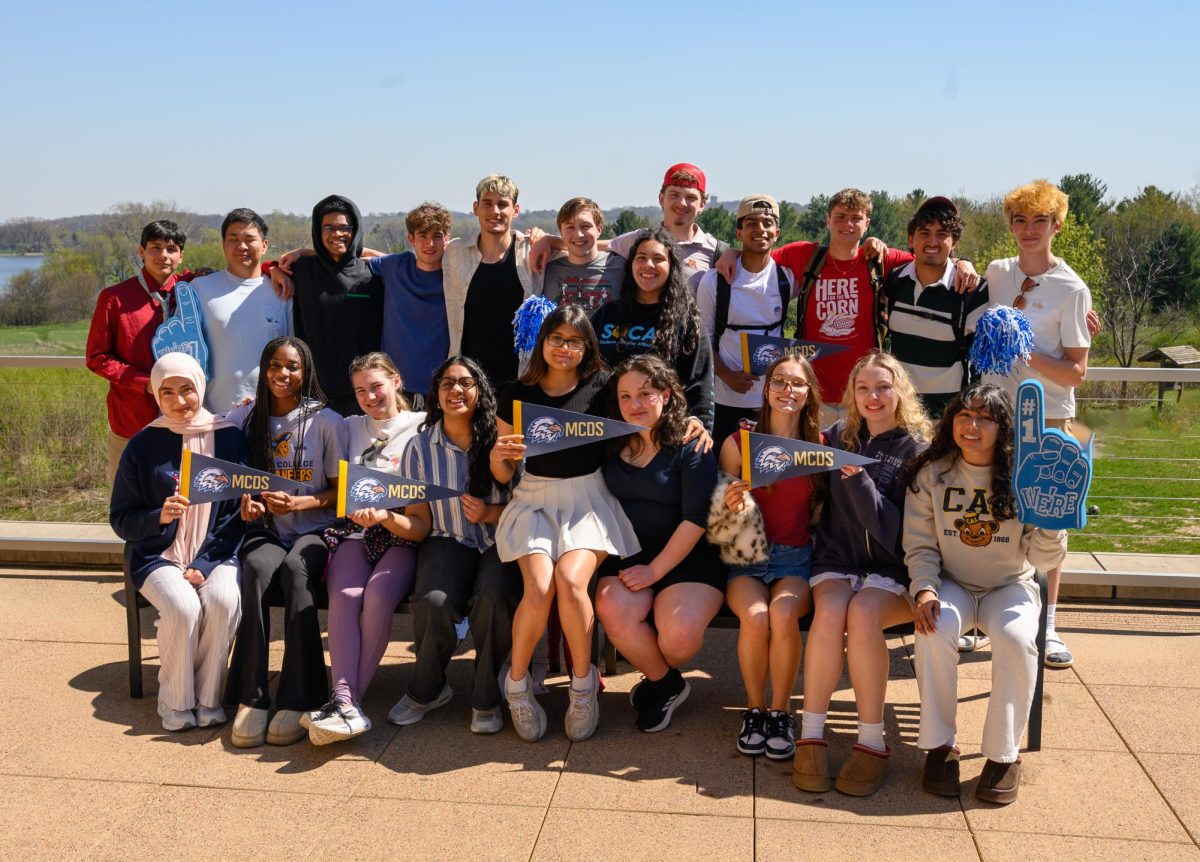
MCDS seniors finalized their college plans this spring, choosing schools from Sitka, Alaska, to Pittsburgh, Pa., after months of essays, tests and campus research that many described as both demanding and rewarding.
May 1 was Decision Day and the Class of 2026 has chosen a diverse range of schools. Several seniors will enroll at the University of Wisconsin-Madison this fall, while classmates head to schools including Carnegie Mellon University in Pittsburgh, the University of Saint Thomas in Houston, Texas, and Outer Coast in Sitka, Alaska.
“Our graduates will find themselves at a diversity of schools that wonderfully match their aspirations,’ Head of School Mark Brooks said in his May Head’s Letter. “They are excited to continue their studies at large, flagship research universities such as the University of California-Berkeley, the University of Minnesota, Purdue University, and the University of Wisconsin-Madison, while others will find themselves on smaller, liberal arts and sciences campuses such as Beloit, Lawrence, Madison College, and Smith.”
“And just like Goldilocks, a handful of students found their best fit at the well-known, midsized, metropolitan universities of Carnegie Mellon, Tulane, the University of Chicago, and Washington University in St. Louis,” Brooks wrote.
Seven seniors will be the first MCDS graduates to attend their respective schools, including Outer Coast in Sitka and St. Thomas in Houston.
Outer Coast, where Ben ’26 will enroll this fall, is a new program. Founded in 2024, the college centers its model on academic study, meaningful labor and student self-governance. It was its Alaska Native language and culture programs that set the school apart during Ben’s search.
“There’s nothing else like it,” Ben said. “It’s so interesting.”
Jae ’26 said they chose the University of St. Thomas Houston, because of “that tight-knit feel where professors actually know your name.”
“It seemed to have that balance of school and fun,” Jae said.
For Anya ’26, Carnegie Mellon stood out for its interdisciplinary approach to education, its strong entrepreneurship programs and its Pittsburgh campus.
“I was really drawn to the idea of being able to explore and learn across different fields,” she said, adding that the campus itself sealed her decision. When her acceptance letter arrived, the moment felt surreal after months of hard work. “Crossing the finish line,” she called it.
As these seniors head to college, Anya also offered advice to underclassmen: Brainstorm personal essays the summer before junior year and finish standardized tests early to reduce the stress load during application season.
Several seniors echoed that theme, stressing the importance of starting the process early. Students noted that preparation during junior year, from standardized testing to essay drafts, made a significant difference when college application deadlines arrived.
Seniors also urged underclassmen to prioritize personal fit over school prestige. Many said they spent time researching campus culture, academic programs and location before finalizing their college lists.
“You don’t have to want to go to a college your parents or friends want you to go to,” said Hasini ’26, who will attend UW-Madison. “Just pick the college that’s right for you, because that’s where you will spend the next four years.”
Students encouraged underclassmen to take advantage of available support systems. Meeting one-on-one with counselors, asking teachers for guidance and staying organized were all cited as key strategies, and seniors cautioned against procrastination.
“Just know you have a great team of teachers, counselors and peers all around you,” Jae said. “Feel free to ask for help, and you will do just fine.”
The school’s college counseling department plays a central role in guiding students through the process. According to Director of College Counseling Matt Koehler, the program spans all four years of high school. Students begin by exploring their interests and strengths, then move to academic planning, college research and, finally, completing applications.
“We work with students over four years to help them understand themselves, build strong academics and ultimately find the right fit,” Koehler said.
Students meet one-on-one with Koehler throughout the process, a feature seniors say sets MCDS apart.
“Take advantage of these one-on-ones, because they are just so useful when you know nothing about the college process,” Anya said.
Koehler said supporting students through the process is his priority.
“My entire job is to help you guys get through the process as smoothly and easily as possible,” he said.